Blog

  • New FNB Plans Approved by Commission

    New FNB Plans Approved by Commission

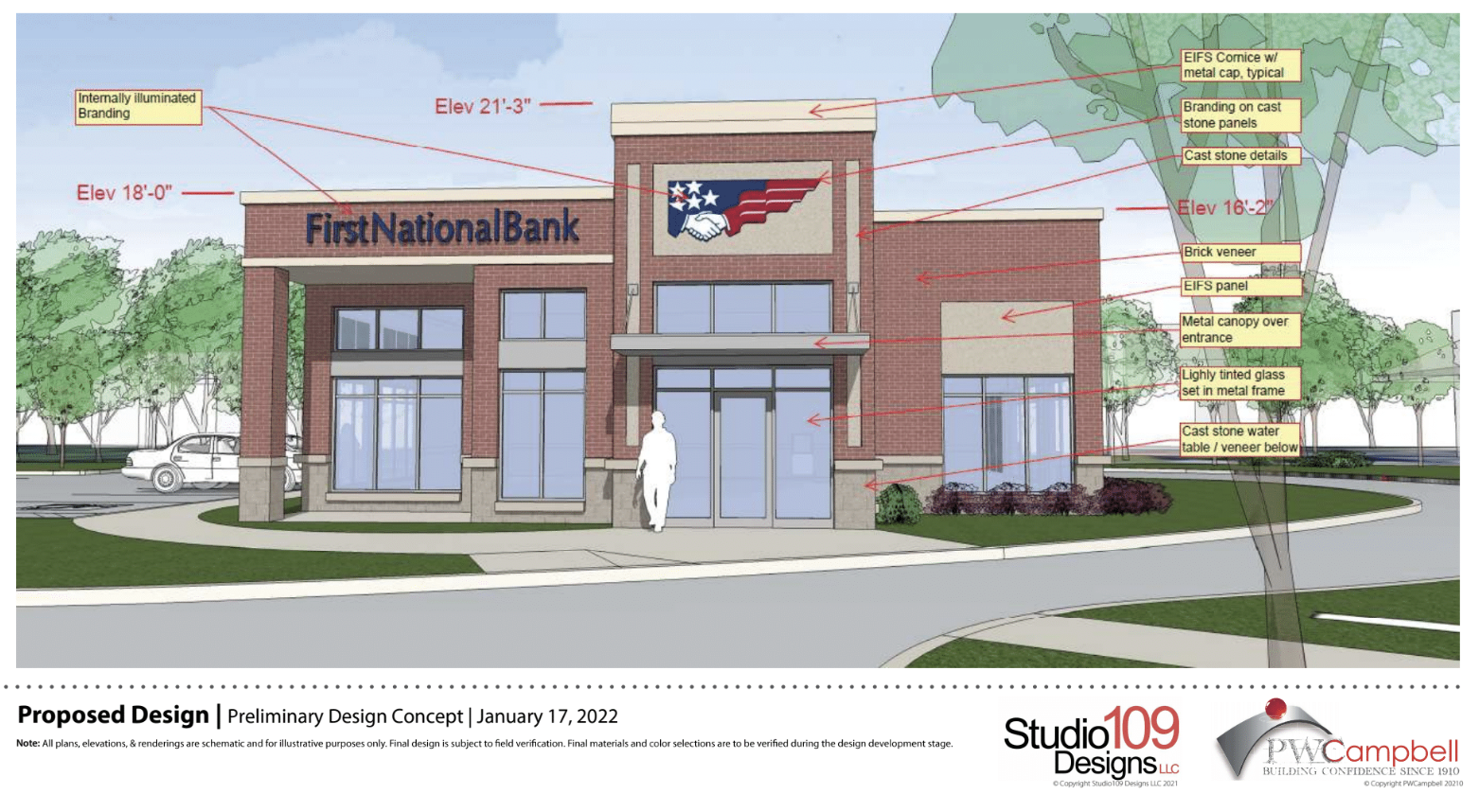
    Last Tuesday, the Mt Lebanon Commission approved the plans for the development of a new FNB Bank to be placed at the location of the existing (and empty) Dollar General store on Cochran Road. I thought it would be a good time to further discuss the development process, this time from the standpoint of our SALDO.

    What is the SALDO?

    SALDO stands for Subdivision and Land Development Ordinance, which are the rules and regulations that makeup how the land can be subdivided and developed within the municipality. The SALDO goes hand-in-hand with our Zoning code and building code, which, together make up all the rules and regulations that govern property development, redevelopment, land usage, and the rules on how buildings can be constructed.

    The Zoning code determines what TYPE of property can be developed or built in any specific area. For example, C-1 is a commercial zone that allows commercial buildings, office space, and other business types. R-1 is single-family residential. R-2 allows multifamily properties, but only of relatively low density. Inside each section of the zoning code, you will find information that further defines the rules and regulations of what can be done in any zone, like whether fences or pools might be allowed, the types of and widths of roads and driveways that are required, etc. The Zoning code is a very versatile document and usually the first stop for any property developer looking to build in Mt Lebanon.

    After a developer consults the Zoning code to see if a specific building type is possible on a particular parcel, they consult the SALDO which sets out design standards and gives developers further information about how that property can be developed and the procedure for turning in documents for the development. For example, the SALDO sets forth rules for Stormwater Conveyance and Management, Sanitary Sewers, Handicapped Accessibility, Landscaping and Screening Standards, Pervious Pavement, and other items. The SALDO sets construction hours between 7:00 am and 7:00 pm Monday through Saturday, all day Sunday and on federally designated holidays. It also sets the required turning radius for cul-de-sacs to allow for emergency vehicles to navigate them properly, and where sidewalks should be provided, if at all.

    The Development Process

    We discuss the overall real estate development process in depth in another article, but the general process goes like this:

    Present Plans to develop a property

    The Planning Commission reviews the submission to make sure that plan follows the zoning code and SALDO. If there are elements of the plan that do not fit the zoning code, the developer can appeal to the Zoning Hearing Board and ask for a variance. If there are elements of the plan that do not fit the SALDO they can ask for a waiver from the Commission.

    There are only 5 reasons to approve a variance, and since this is a quasi-judicial board, those 5 reasons are legal thresholds that must be met. This is the reason so few variances are granted. If the developer (or resident) doesn’t like the decision of the Zoning Hearing Board they can appeal that decision to the Court of Common Pleas in Allegheny County. There have been several appeals of our ZHB decisions in the past 6 years. None of them have succeeded at the county level.

    A developer can ask for a waiver from any of the requirements of the SALDO, and these are reviewed directly by the Commission. And this is where my story picks back up.

    SALDO WAIVERS

    Waivers are not usually requested for single-family developments or smaller commercial properties – because they can be easily developed within the rules of the SALDO. When developers attempt to fit too much on a lot, or save a few dollars on items we require but other neighborhoods don’t, the Commission might see more waiver requests. And that’s what happened with the FNB recently approved.

    Section 704 of the SALDO sets forth rules about sidewalks. Section 704.1 simply states:

    In all subdivisions and land developments, sidewalks shall be installed along the portions of the property abutting a street.

    Section 704.1. Mt Lebanon SALDO

    That means when someone proposes a new development or redevelops an existing property, if they abut a street (public, private, or otherwise designated) a sidewalk, if it does not already exist, must be installed.

    Being a “walking community” you can imagine why this portion of our SALDO is extremely important. Yet sidewalk requirements are not implemented consistently and their application has varied from commission to commission. That’s why we see some roads have them and some roads don’t.

    FNB Requests Sidewalk Waiver

    During the development process, the developers of the new proposed FNB requested a sidewalk waiver for the street abutting their property — the northern property boundary with Ferren Alley. The developers claimed, among other things, that the land coming off the alley was too shallow and too steep such that following the SALDO would cause the developer to expend additional funds to install a sidewalk. To install a sidewalk, they would have likely had to ease the slope coming off the alley, which in turn would have likely required ground fill and potentially a stabilizing wall.

    However, the SALDO does not allow for considerations related to expense, it merely sets forth best practices for building and development. And that’s the way it should be.

    The developer tried to further obfuscate the issue by offering to install extra screening trees to effectively block the view of the building from residents along the alley. In doing so, they shift the conversation from the Municipality requiring safe sidewalk access on all roads to a conversation about residents seeing beautiful trees instead of a monolithic building facade.

    In the end, the Commission voted 4-1 to approve the waiver and allow the development; with one dissenting vote from me. It was my opinion the developer should follow the SALDO and install the sidewalk, even on the abutting alley. Wanting to save a few dollars during development is not a reason to seek waivers from our SALDO.

    Why This Matters

    If you live on a private road, alley, or “paper” street that the municipality does not own, the maintenance of that road falls to the abutting property owners. The municipality may, from time to time, still plow that road in an effort to keep it clear for potential emergency vehicles, but doing so is not the municipality accepting responsibility for that road. Those roads, since they were not required to follow public road standards, seldom have curbs, seldom are made of concrete, and seldom have storm water management. The cheap asphalt gets eroded, mud from the lawn makes it way into the road and down the street, and ice spots often occur here in winter. This is why these roads often fall into disrepair. It’s also the reason for many of the road maintenance complaints we get as commissioners. And for good reason. These types of roads really shouldn’t exist. And even if many of them were created before we had rules governing road development (like we do now), the SALDO works to correct those former deficiencies by requiring new developments to bring the properties up to modern standards.

    Had the developers of the FNB followed the SALDO, they would have been forced to install sidewalks, which forces them to build curbs. Does it cost more to build? Yes, it does. But it brings our roads up to modern standards, provides more sidewalk space, allows for better stormwater flow, and makes our roads and neighborhoods moderately safer, and easier to navigate.

    Some would claim this road is just an alley and there isn’t much traffic and forcing a developer to build a sidewalk there on the back or side edge of a bank is superfluous. The SALDO doesn’t set forth rules for minimal traffic to be met before sidewalks should be installed. It doesn’t set forth rules for the type of street on which sidewalks should be installed. It doesn’t set forth property types that require or don’t require sidewalks. They all do.

    Official Documents

    Official information related to this development can be found on the publicly available municipal website. There, you’ll find building renderings, a development plan, and a timeline of official proceedings.

    Let Me Know Your Opinion

    Drop a comment here on the post and it will show up for others to read here and in the main site activity feed.

  • Why Do We Need Open Lebo?

    Why Do We Need Open Lebo?

    What follows below is the short story behind why openlebo.1wp.site/ is needed, how it got started, and how you can participate.

    Who Is Behind openlebo.1wp.site/?

    This site was started by Craig Grella, a resident and, at the time this site was created, elected Commissioner in Mt. Lebanon’s 4th Ward. What is important to understand is that this site has no official affiliation with the Mt Lebanon Municipality or Mt Lebanon School District. My views, comments, and other content posted here are solely my views and do not reflect the opinions or official workings of the School District or Municipality in any way. Other elected officials may, from time to time, post on this site as well, and when they do that content will be their sole opinion and not the opinion of the bodies they were elected to represent. I’ll explain more on this in just a minute, in the meantime — if you want an official opinion or comment from the municipality or school district on any topic I recommend you visit those official channels:

    Why openlebo.1wp.site/?

    The idea for a site like Open Lebo first came to me in 2019, a little over a year after being elected as Commissioner. There are so many important issues to discuss, and most of them require more than a cursory review — they require deep thought, review from all angles, input from all stakeholders, and comment from fresh eyes. I quickly learned that there was just not enough time to dive into all the important issues facing our community during two commission meetings each month or the discussion sessions that preceded them. With families, sports, dinner time, and the timing of the official meetings — very few residents could take time out of their busy schedules to attend. So more goes unsaid, unnoticed, and unexplained until something blows up (figuratively speaking). 

    I started to think there must be a better way to continue these conversations outside of official channels — to give people the information they needed, in an informal way that didn’t require deliberation or break the rules of public governance. 

    There are a few community groups that popped up on Facebook and other social networks where residents could get together and post interesting stories. But like most networks, those are chronological walls and topics get quickly buried under newer posts. Networks like Facebook are notoriously hard to search, and others, like Twitter, while searchable, quickly lose context when taken out of the chronological order they were designed to encourage. Networks like that also suffer from the same question being asked over and over again – it’s what makes group moderators burn out and leave because on those networks comments and posts can’t be merged into similar topics. They just run again. Get buried. Get asked again. Get buried. Asked again. Buried. It’s a never-ending silly game that the network creators don’t care to solve.

    The fact is, those networks just weren’t built for community conversations. Not to mention they mercilessly track you across the web, sell your data to the highest bidder, and are used mainly now to spread hate and division. In fact, their business models depend on it. See Facebook Whistleblower Frances Haugen’s Senate testimony and the award-winning documentary The Social Dilemma for more on that assertion. It was clear to me that Facebook and most of the other social networks are not the answer. 

    Other team tools like Slack and Discord also don’t work. They lack the sophistication to properly organize community conversations — they too are merely chronological posting walls that focus only on the here and now. 

    I knew that we needed a better way, and probably a better format, to have broad-based community conversations but couldn’t find a tool that would allow me to do it the way I thought it should be done.

    I started to have conversations with other commissioners and school board directors who felt the same way — that there was just never enough time to dig into all the things we needed to discuss. We started to create a framework for a website that would allow members of the public to have the best of what the social networks offer, but also allow for organization required for real community building. I knew we needed the ability to:

    • Post quick status updates so that friends and family can follow you and stay up to date; as you can on Twitter, Reddit, or Facebook.
    • Post questions and get quick answers from the community; like you can on pretty much every social network.
    • Post images, gifs, videos, links, and other media; like Instagram, and also because they’re awesome.
    • Create longer-form articles; as you’d see on news sites and popular blogs.
    • Create and join social groups; like on Facebook, Google, and MeetUp.
    • Send private messages to community members or group messages to an entire group.
    • Make public only the info we wanted public and keep private the info we want to keep private.
    • Prevent our data from being sold to third-parties and advertisers across the world.

    In early 2020, I created the first version of openlebo.1wp.site/ and ran it by the Municipal solicitor to make sure it was providing enough separation from what I was doing as a Commissioner but still allow me and other private residents to continue the public conversation on important issues. Then, just a few months into 2020, the COVID-19 pandemic took center stage, forcing everything else to the back burner.

    Commissioners, school directors, municipal and school staff, and government agencies at every level spent countless hours trying to understand the implications of this new unseen threat, and, more importantly, figuring out ways to keep the public safe. The situation was so fluid, with guidance changing almost hourly for the first few months of the pandemic. Laws were created by our State Legislature, then changed, then changed again. Orders were put in place by our Governor and Health Department, then changed, then changed again. In the meantime, businesses were closing, people were staying home, and the economy teetered on the edge of a cliff.

    As the pandemic worsened, it was clear that certain people in Mt. Lebanon were going to need extra help. I worked with other members of the Commission and municipal staff, and staff and council members from the Borough of Dormont, and State Rep Dan Miller to create a site called Neighborhood Aid, which would take requests for grocery deliveries from those unable to visit stores by themselves. Later, we’d add medicine and pharmacy pickups, and other errands that residents could no longer do while on mandatory stay-at-home orders. In the first few months of the pandemic, we received hundreds of requests all of which were filled by residents who volunteered to shop and make deliveries to those who couldn’t leave their homes. We put a simple, low-tech process in place and the residents and administrators made it all work beautifully. Have a need – call or send an email. Want to volunteer – call or send an email. We brought the two sides together – something the municipality had been unwilling or unable to do in the past.

    I’d worked in community organizing before, and had seen how distributed teams could bring about big changes in an organized fashion. But mostly that model was put to use on political campaigns and political issues. But here, I wanted to make it work with the local government. That inspired me to bring the distributed community model to OpenLebo, which, at the time, was still in development.

    Around the same time, a man named Ahmaud Arbery was shot and killed in Georgia. A woman named Breonna Taylor was killed a few months later, and George Floyd a few months after that. The community response from each of these murders was instant, and with each successive incident, the voice grew stronger and more sustained. Even though these events took place hundreds of miles away, and even though we still found ourselves in the grips of a continued health crisis in the pandemic, we all knew that something needed to change with the way our communities were interacting with our governments.

    Finally, in 2021, the Mt Lebanon Commission set up diversity, equity, and inclusion (DEI) groups working as ad-hoc subcommittees of the community relations board. Four groups were created and their members were tasked with researching how we might become a more diverse, equitable, and inclusive community and then making recommendations to the commission on how we might achieve our ultimate goal. I was honored to be the commission liaison to the DEI Group 3 – which worked closely with the Mt. Lebanon Police Department. That experience taught me three things:

    1. Communication is paramount, and that we must listen more than we speak.
    2. If we want something different than what we have now, we have to do things differently. We have to think differently, act differently, and we cannot settle for the way things have always been done.
    3. To change a culture at its roots you need to act with new principles, new actions, new policies, and new laws across the board and in everything that you do. That means with relationships between people, in how we communicate, how we create and maintain rules, order, laws, how we treat other people, even how we refer to ourselves and others. That spirit has to infuse everything we do.

    With those experiences fresh in my mind, and with the understanding that we can’t just sit by and wait for someone else to solve our issues, I finished the framework for this site and launched it on the interwebs as a resource for everyone in Mt. Lebanon.

    So What Is OpenLebo?

    I have a hypothesis that open communication makes everything better, and openlebo.1wp.site/ is the experiment by which I hope to prove that hypothesis correct.

    openlebo.1wp.site/ is simultaneously a Q&A forum, group platform, social activity feed, and member sharing site — and its goal is to make Mt. Lebanon a more open, transparent, and welcoming place where we can:

    • Share ideas about how we make Mt. Lebanon a better place.
    • Call out harmful habits and situations when we see them — like discriminatory rhetoric and actions. Not to shame those people, or to call them out for being bad, but to help them understand how their actions might be harmful to others and to work with them to end that behavior.
    • Encourage others to be better, more welcoming neighbors to all those who live in, work in, or visit Mt. Lebanon.
    • Inform and communicate with our neighbors about interesting events.
    • Encourage activism and civic participation.
    • Provide a good example of positive communication for students, youth, and the next generation of residents, business owners, and leaders in Mt. Lebanon.
    • Pickup the conversations started by our local governement and school board, dive deeper into them, and expand on all imaginable angles so that all residents can more clearly understand the existing and proposed policies and how they might affect us all in our daily lives.

    And That’s Where You Come In

    Open Lebo can’t succeed in a vacuum. To work, it’s going to require lots of content, some organization, and a ton of community cooperation. In short, it needs as many residents as are willing to participate in this experiment to improve communication between all Mt. Lebanon residents, including those who are here now and those who might be here a few years from now.

    There’s so much this site can become — a job board for local residents looking to start or change careers, a place where those in need can find volunteers to help, a marketplace for the exchange of local goods and services, and community events calendar. It’s all possible, and, as with every journey, it all starts with the first step.

    To get you started, I’ve put together a few helpful articles and video tutorials on how to use the site.

    If you’ve read this far into the longest blog post ever, thank you! Again, I hope you will join me on this journey by reading our rules of the road and then introducing yourself here.

    If you signed up to be a member of this community, you’ve already agreed to the Terms and Privacy Policy. If you haven’t done that yet, I encourage you do read both those pages. They’re important. Also, you should read the User Guidelines which govern how we want people to interact on this site. 

    If you have any other questions post a note in our support forum or send me a note at craig@craiggrella.com or to community admins at info@openlebo.com.

    I hope you enjoy (and participate in) the site!

    Craig Grella